Musimack Marketing 

/ SEO Services / 

AI Visibility Reporting

SEO for Multi-Location Brands 

Musimack helps established businesses coordinate local SEO at scale so each location is easier to understand, easier to evaluate, and better supported by the systems that influence local discoverability.
Book A Consultation
Musimack Marketing Woman Looking at Phone

The Problem With Multi-Location Visibility

Local SEO gets harder when every location, office, branch, or service territory has its own pages, profiles, reviews, data, and market conditions. 

When a business grows across locations or markets, local visibility often becomes uneven. One location may have strong map visibility, clear profile information, useful local content, and steady reviews, while another location may have thin pages, inconsistent data, unclear reporting, or missing local proof.

That does not always mean one location is being managed poorly. It usually means the local visibility system has started to drift. Pages, profiles, services, hours, reviews, links, tracking, and local market signals may no longer tell the same story.

Multi-location businesses need a way to identify those gaps without reducing the work to rank tracking, copied city pages, or one-time profile cleanup.

We look at how location pages, Google Business Profiles, local data, review workflows, reporting signals, and rollout needs work together. The goal is not to promise every location the same result. The goal is to create a clearer local visibility system so leadership can see where attention is needed and what should be prioritized next. 

What Multi-Location SEO Really Coordinates

Multi-Location SEO is local SEO at scale. It helps a business keep local search signals accurate, consistent, locally useful, and measurable across multiple locations, offices, branches, regions, or territories.

The work is partly about consistency and partly about local distinctness. A brand needs shared standards for data, profiles, service information, and reporting, but each location also needs enough useful detail to reflect the market it serves.

Musimack helps coordinate the pieces that often get managed separately: location pages, Google Business Profiles, local data, local content, reviews, reporting signals, rollout planning, and local AI discovery readiness where relevant.


Pages
Profiles
Data
Reviews
Reporting
Rollout
Readiness
Musimack Marketing Woman on the Phone

The Multi-Location Visibility System

Multi-location visibility works best when the key components of the local ecosystem support one another. A location page should match the profile it represents. Local data should align with the website and trusted third-party sources. Reviews and local proof should support buyer confidence. Reporting should help the team see patterns by location, market, branch, or region.

 When those pieces are disconnected, it becomes harder to know whether the issue is content, profile accuracy, local competition, location data, service-area logic, tracking, reviews, or something else. A coordinated system makes the work easier to prioritize. Musimack looks at the system as a whole, then helps identify which parts need attention first.

pages

profiles

data

reviews

reporting

Rollout

local AI discovery readiness

Core Service Components

Multi-Location SEO can include several connected work areas depending on the business, its access, its data, and the condition of its local visibility system. The goal is to focus on the components that will make the system clearer, more accurate, and easier to manage across locations.

Location Architecture

Plan location, office, branch, region, and service-area page logic with crawlable structure and internal links.

Profile Coordination

Align profiles with the right location pages, services, hours, links, and local details.

Local Data Consistency

Review how location data aligns across the website, profiles, citations, and directories.

Local Content Distinctness

Support useful local variation through services, FAQs, proof, photos, staff details, or market context.

Review Workflow Coordination

Organize review monitoring, response consistency, escalation needs, and ethical request alignment.

Location-Level Reporting

Review available signals from GBP, GA4, GSC, Local Falcon, CallRail, form fills, and bookings where available.

New Location and Market Rollout

Support launches, moves, closures, acquisitions, service-area changes, and expansion markets.

Local AI Discovery Readiness

Improve the clarity and consistency of local information AI-assisted discovery systems may encounter.
Musimack Marketing Woman on the Phone

Location-Level Accountability

Leadership teams often need more than a brand-level view of local visibility. They need to understand which locations may need attention, which markets are showing different patterns, and where the next round of work should be prioritized.

 Where data is available, Musimack can review signals from Google Business Profiles, Google Search Console, GA4, Local Falcon or comparable scans, CallRail, form fills, bookings, route requests, and other location-level sources. These signals do not create complete attribution, but they can make location-level conversations more practical and less dependent on guesswork.

 The purpose is to support better prioritization, not to turn the page into a reporting dashboard product.
GBP signals
GSC
GA4
Local Falcon
CallRail
Form fills
Bookings
Route requests

Local Falcon and Visibility Diagnostics

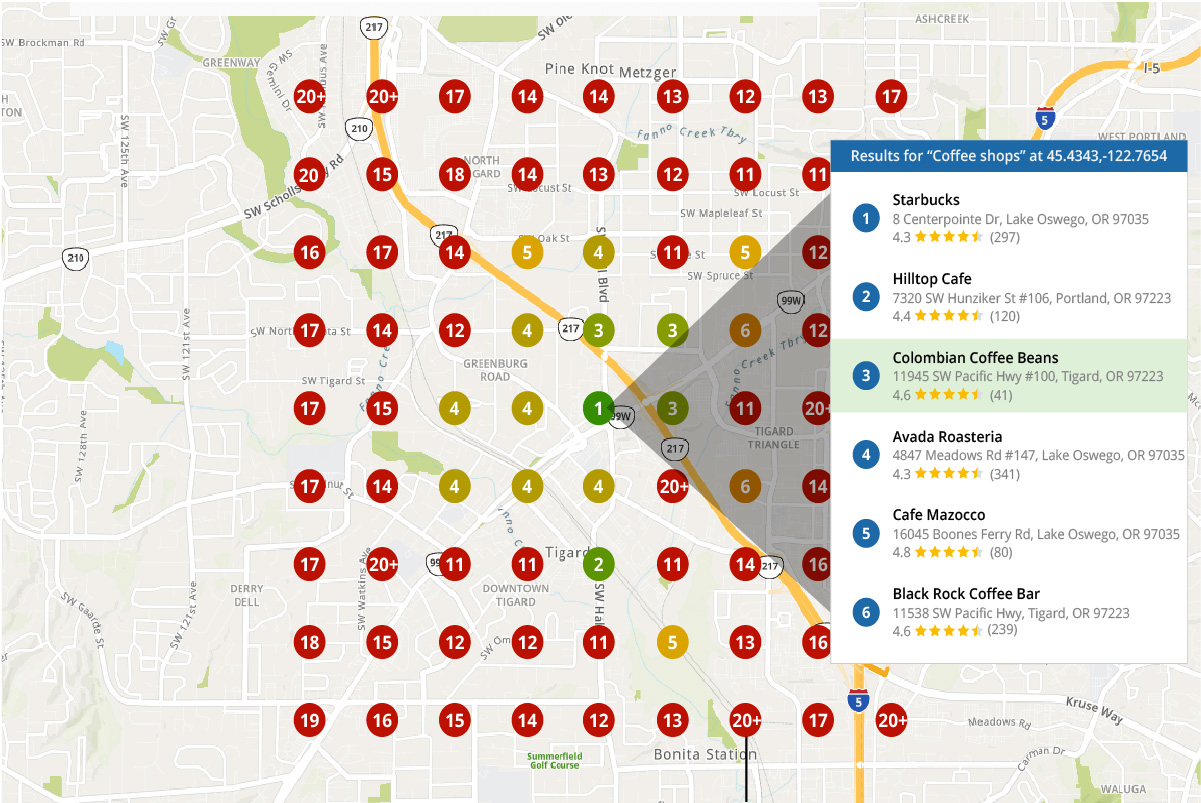
Geo-grid diagnostics can help show how local visibility changes across the area around a location, office, or service market. They can reveal current-state visibility patterns that may not be obvious from a single search, a brand-level report, or one overall ranking number.

Musimack may use Local Falcon or comparable visibility diagnostics where relevant to help evaluate local patterns, compare markets, and prioritize deeper review. A scan is not a guarantee of future rankings. It is a diagnostic input that can help show where the local visibility system may need more attention.

Used carefully, this kind of visibility pattern review can help teams ask better questions: Is the profile aligned with the right page? Is the location page useful enough? Is local data consistent? Are reviews, categories, service details, and local proof supporting the location clearly?

Example visual is conceptual. Geo-grid diagnostics show current-state patterns and do not guarantee rankings or map pack placement.

Physical Locations, Service Territories,  & Franchise-Like Models

The clearest fit for Multi-Location SEO is a business with multiple real locations, offices, branches, showrooms, clinics, restaurants, venues, or regional markets. These businesses usually need a coordinated system for location pages, profiles, local data, reviews, reporting, and local updates.

Service-area businesses can also be a fit when they have real territory complexity across cities, counties, regions, or service markets. The strategy has to be handled carefully because service territories do not work exactly like physical storefronts. Franchise and franchise-like organizations can be a supporting use case when consistency and local distinctness both matter. The page should not be read as a franchise-only service, but the same coordination problems often show up in franchise, branch, and regional structures.

How the Engagement Can Work

Multi-location SEO does not have to begin as a massive overhaul. Many engagements start with a review that helps clarify what is already working, where the system is inconsistent, and which locations or markets deserve attention first.

From there, the work may move into a roadmap, cleanup, launch support, or ongoing optimization, depending on the business and the issues found.
1

Review

Evaluate location pages, profiles, local data, visibility patterns, content distinctness, reporting signals, and known operational changes.

2

Roadmap

Prioritize locations, profiles, pages, markets, content gaps, tracking gaps, or rollout needs.

3

Cleanup / Launch Support

Improve alignment across pages, profiles, data, reviews, reporting, and new-location or market-launch needs.

4

Ongoing Optimization

Monitor and refine the system as locations, competitors, markets, profiles, and business details change.

1
Discovery
We learn your business, goals, audience, & competitive landscape before we start.
2
Audit
Technical review of your site structure, content gaps, rankings, & current search presence.
3
Foundation
We fix the fundamentals & build the structure that makes everything else work better.
4
Ongoing strategy
Monthly work, reporting, & strategy to grow & protect your visibility over time.

AI-Assisted Local Discovery Readiness

AI-assisted search and discovery make local clarity more important, not less. When location information is accurate, accessible, consistent, and supported by useful local content, search engines and AI-assisted systems have a clearer picture of what each location does and who it serves.

 For multi-location businesses, that means local data, location pages, profiles, reviews, service details, and entity consistency matter across every market. Musimack can help improve readiness and evaluate available visibility patterns where tools and data allow. No agency can guarantee AI recommendations, citations, answer wording, placement, or inclusion. The practical work is to improve the clarity and consistency of the information those systems may encounter.
Accurate location data
Clear location pages
Profile and review consistency.
Readiness for AI-assisted local discovery

What We Need to Evaluate the System

A useful Multi-Location SEO Review depends on accurate location information, access to the right systems, and enough operational context to understand how locations differ. The stronger the inputs, the more useful the review can be.

Helpful inputs may include a location list, NAP data, hours, service areas, location-specific services, website access, Google Business Profile access, Google Search Console, GA4, GBP data, Local Falcon or comparable visibility diagnostics, CallRail, form fills, bookings, local photos, reviews, FAQs, staff details, and notes about openings, relocations, closures, acquisitions, or service-area changes.

Not every engagement requires every input at the start. The point is to understand what can be evaluated, what is missing, and what needs to be prioritized.
Location data and business details
Website, profile, and reporting access
Local proof and content inputs
Operational changes and rollout context

Related Local SEO and Visibility Services

Multi-Location SEO falls under Musimack’s broader SEO and AI Visibility (GEO) service family, but it has a specific role. It focuses on coordinating local visibility across multiple locations, offices, branches, territories, or markets.

Some needs may belong on a related service page. Single-location visibility belongs closer to Local SEO. Deep profile completeness is part of Google Business Profile Optimization. Review response and ethical review workflows may connect to Reviews & Reputation Strategy. Broader dashboards and reporting methodologies fall under Visibility Reporting. Calls, forms, bookings, lead quality, and deeper attribution belong to Search-to-Lead Mapping. Broader AI-assisted search readiness belongs to AI Search Visibility.

Those services can support the work, but this page stays focused on local SEO at scale.

Request a Multi-Location SEO Review

If your locations, offices, branches, territories, or markets are showing uneven local visibility, start with a clearer view of the system. Musimack can help review how your pages, profiles, data, reviews, visibility patterns, and reporting signals work together, then identify what should be prioritized next.
Schedule a Consultation